
“Avoidance feels like relief in the moment, but will only strengthen the feeling you’re trying to escape.”1 –Mark Manson
At 30 years old, I was severely depressed. I was also a marijuana addict. You might think that one problem caused the other, but it’s more complicated than that.
My depression was not caused by my addiction: I was depressed because I’d suffered a string of injuries that left me in constant pain and prevented me from doing the things I loved.
And my addiction was not caused by my depression: I’d been a marijuana addict – mostly happily – for over a decade.
And yet, my addiction and my depression were inextricably linked. And getting sober did cure my depression.
Why?
Dopamine
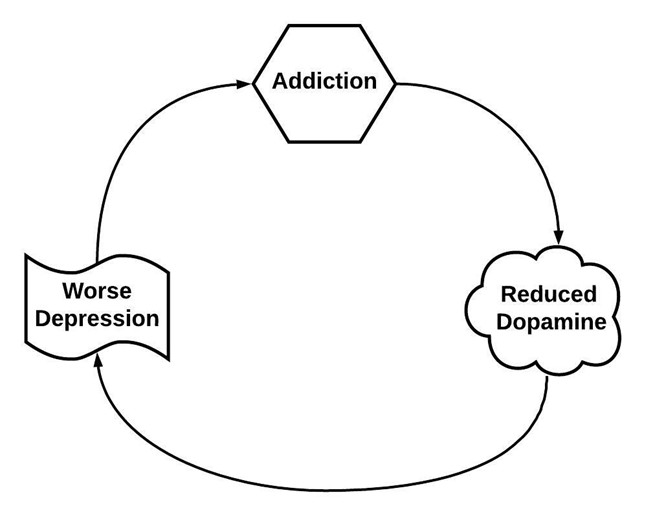
The first reason is neurological. When you’re addicted, your brain downregulates dopamine production and receptors, making it harder to feel good in your normal state.2 At first, you use drugs to feel good, but eventually, you use them just to feel okay, to get back to your old baseline level of happiness.
Studies have shown that it takes four weeks for your brain to reset. For instance, when alcoholics who are also depressed get a 4-week treatment for their addiction but no treatment for their depression, they nonetheless overcome their depression.2
Now, this sounds like addiction causing depression, but really it’s addiction making you more likely to become depressed. And since depression makes you more likely to use drugs to feel better, the two feed off one another in a downward spiral:
The Pleasure-Pain Seesaw
According to Dr. Anna Lembke, author of Dopamine Nation, the simplest way to remember how this works is to imagine that pleasure and pain are a seesaw in your brain. Pushing down on one side of the pleasure side of the seesaw causes the system to become unbalanced. Your brain wants to return to homeostasis (biology-speak for balance), so it pushes down on the other side.3
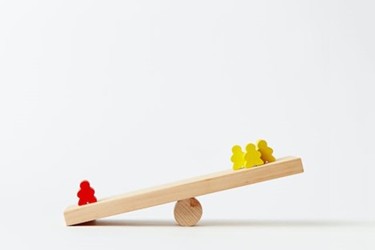
So when you indulge in drugs for pleasure, your brain will compensate by making you feel pain. The pain can be physical, emotional, or both.4 I was using marijuana to mitigate the physical pain of my injuries, which helped in the moment, but made the pain come back worse later. At the same time, I was getting high to “deal with” the psychological pain of depression, which only made my depression worse in the long run.
Numbing
The down-regulation of dopamine explains something Brené Brown observed about numbing our pain by indulging in pleasure:
“You can’t numb those hard feelings without numbing the other … emotions. You cannot selectively numb. So when we numb those [bad feelings], we numb joy, we numb gratitude, we numb happiness. And then we are miserable, and we are looking for purpose and meaning, and then we feel vulnerable, so then we have a couple of beers and a banana nut muffin. And it becomes this dangerous cycle.”5
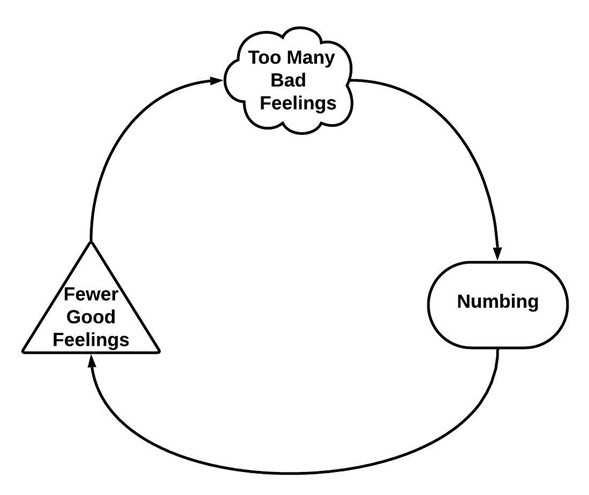
It’s understandable to want to avoid bad feelings, but the cost is too high. Depression is sometimes described, not as sadness, but as the absence of joy. The more I numbed my negative emotions, the more I cut myself off from the very feelings that make life worth living.
Resistance
So if you can’t numb your pain, what are you supposed to do?
The simple – but difficult – answer is to accept it.
Remember: Suffering = Pain x Resistance
We all experience pain. It’s the resistance to pain that causes us to suffer.6 It is by fighting pain that we cause ourselves agony.
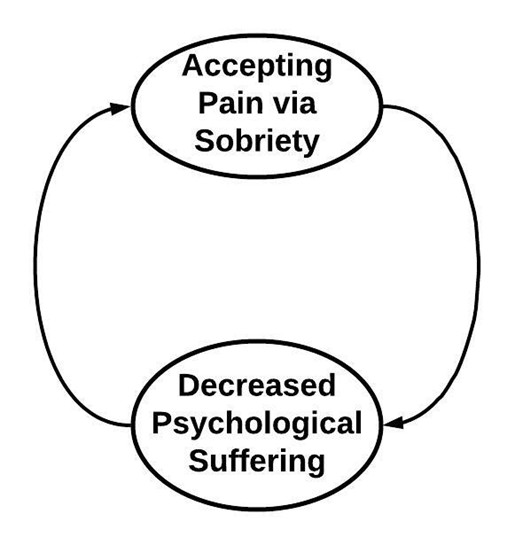
Using alcohol and other drugs to numb or distract from pain is a form of resistance. And while this self-medication is understandable, the relief it brings is short-lived. When the pain comes back – and it will – you’ll suffer more from it because you’ve chosen to resist. That suffering, in turn, drives you to further drug use:
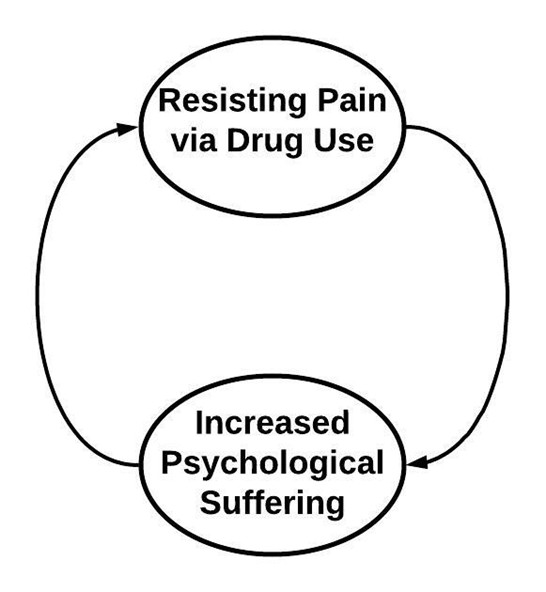
When I got sober, I basically said, “Hey pain! Let’s hang out. Let’s get to know one another.” And suffering was like, “Well this is awkward. I’ll just leave you two alone.”
I wasn’t happy to be in pain, but by accepting it, I reduced its power over me. My suffering diminished, which made it easier to stay sober:
Avoidance
The most important reason sobriety cured my depression is that it forced me to face my problems head-on, which showed me that I could face them.
I didn’t feel capable of handling my problems, so I was getting high to avoid dealing with them. This, in turn, made me feel even less capable of handling my problems, making me even more inclined to avoid them:
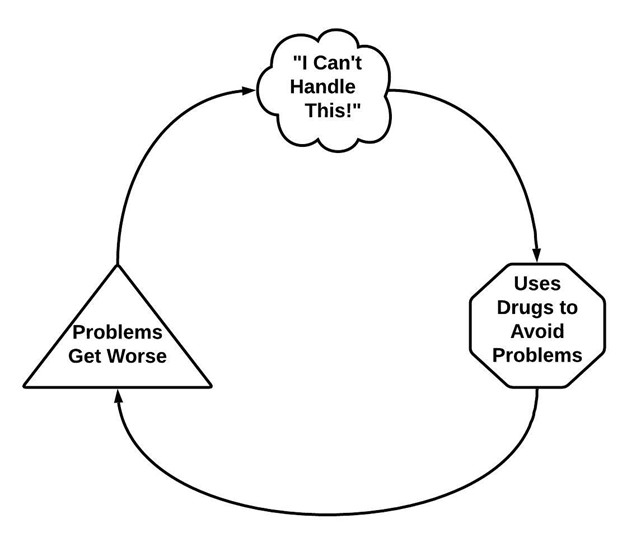
When I got sober, there was nothing between me and my pain. There was no choice but to handle it. And, it turns out, the human brain is surprisingly resilient when resilience is its only option. If you force it to deal with shit, your brain will figure that shit out.
As the fog of addiction cleared, I got to work making my life better. I started taking better care of myself, taking steps to resolve my mental health issues, and working hard to heal my injuries – all things I wasn’t motivated to do when I had the option of just getting high. I discovered that all of my problems had solutions: they could be resolved with strategy and effort. And the act of solving them increased my sense of self-efficacy, making me feel more and more capable of solving any problem:
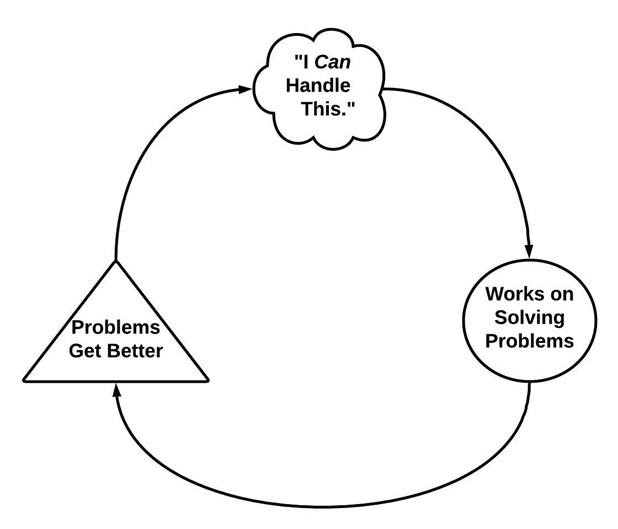
Remember, your brain is always watching what you do. It’s using your behavior to determine who you are, how to feel, and what you’re capable of. Avoiding your problems sends your brain the wrong signal. Facing your problems head-on is how you prove to your brain that you can handle whatever life throws at you.
Integrity
Lastly, getting sober cured my depression because I was finally living with integrity.
I had known for years that I needed to get sober. I wasn’t living a life aligned with my values. I wasn’t living up to my potential. I was hiding my addiction from friends and family. Getting sober resolved all of those incongruencies.
Few things are as important for your mental health as living with integrity. Few things are as intrinsically satisfying as doing what you know you should be doing.

And if you’re currently trying to get sober, leveraging the power of integrity is one of the best strategies you can use. Tell everyone you know that you’re 100% committed to being completely sober for the rest of your life. You won’t want to let them – or yourself – down by relapsing.
1Manson, Mark. “You’re Not Just Distracted.” Your Next Breakthrough. March 9, 2026.
2“With Pleasure Comes Pain -Our Addiction to Dopamine- with Dr.Lembke.” Empowering Neurologist. Episode 131.
3Lembke, Anna, MD. Dopamine Nation: Finding Balance in the Age of Indulgence. Dutton, 2021.
4https://becomingbetter.org/why-indulgence-makes-you-less-happy/
5Brown, Brené. “The Power of Vulnerability.” TEDxHouston. June 2010.
6Neff, Kristin, Ph.D. Self-Compassion: The Proven Power of Being Kind to Yourself . William Morrow, 2011.

Chris Loper has been writing about self-improvement and helping busy adults with habit formation since 2017.
He also writes an education blog for parents and students for Northwest Educational Services.
Along with Greg Smith, Chris is the cocreator of Parenting for Academic Success, a series of transformative classes that create empowered parents, confident students, and harmonious families.
His most recent endeavor combines his academic and habit-formation expertise to help students thrive in college. Visit SmartCollegeHabits.com to learn more.
In 2021, Chris published a humorous memoir titled Wood Floats and Other Brilliant Observations, a book that blends crazy stories with practical life lessons.
He lives in Issaquah, WA where he is the owner of South Cove Tutoring.