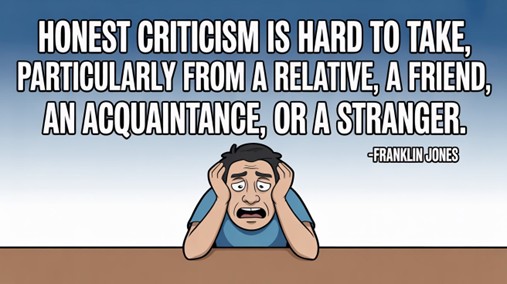
Few things are harder in life than taking criticism well. I find that anytime someone tells me that I’ve done something wrong, no matter how minor, my brain starts generating a long list of reasons why I’m actually right, why their criticism is irrational, and why they’re actually the ones who have screwed up.
This response is, shockingly, not helpful. So I need to get better at taking criticism. And I don’t think I’m alone.
In part, this endeavor is a lifelong practice: cultivating a better mindset about criticism and improving self-awareness. But I’ve also had an insight about why we get defensive that has proven helpful.
Why We Get Defensive
Think about the last time that you got defensive.
What triggered that response?
Of course, it was the implication that you had done something wrong, that you’d made a mistake. And although the mistake might have been as morally insignificant as a miscalculation during a math problem, part of you felt like you were being told you’re a bad person. And no one wants to believe they’re a bad person.

We all want to believe we’re good people.
Because of this, anytime we’re given feedback that implies (or explicitly states) that we’ve done something bad, we react against it. And the more the accusation really is about morality, the stronger our defensiveness.
At the same time that we’re feeling stomach-turning pangs of guilt or the warm wash of shame, we’re fighting against those feelings – trying to make them go away by generating arguments in our own defense. Then, wrongly believing that the best defense is a good offense, we go on the attack, pointing out all of the things our criticizer has done wrong. They become defensive, and the ensuing argument is unproductive and unpleasant for everyone involved.

Here’s how Olivia Fox Cabane puts it in The Charisma Myth:
“If someone feels like they’ve done you harm, they will seek to rationalize their actions and will convince themselves that what they did was justified. They don’t want to feel like a bad person, therefore you must have done something wrong in order for them to act this way toward you.”1
We react so strongly to criticism because of human nature. In hunter-gatherer times, it was essential to be seen as a good person; otherwise you could be kicked out of the tribe, which might have been a death sentence. Overcoming this tendency means overcoming a genetic predisposition we all share, which is no small feat. Luckily, we have logic on our side.
Defensiveness vs. Becoming Better
Ironically, the desire to see ourselves as good gets in the way of actually being good. We all make mistakes, and we all have room to grow. And when we’re told that we’ve screwed up – when we’re told that our actions are harming others – we should use this feedback to change for the better.
Instead, we get defensive, justify our imperfect actions, and refuse to budge.

So learning to let go of defensiveness is critical for our moral development. An important strategy for doing that is reframing our mistakes so that we don’t feel such an urgency to defend ourselves.
You’re not a finished product. Like everyone, you’re a work in progress, and mistakes are simply learning opportunities. In this view, criticism is welcome because it’s an avenue to making progress. And just as we might apply a growth mindset to learning in school, we can apply it to becoming better people.

Math Errors vs. Moral Wrongdoing
If you’re doing a math problem, and you make a miscalculation, does it mean you’re a bad person?
Of course not. It just means you made a mistake, and you need to correct it. The vast majority of the time we’re criticized, it’s because we’ve committed the equivalent of a math miscalculation, not a heinous moral transgression.
If you’re talking to your partner, and you mistakenly use a phrase or tone of voice that comes off as rude, does it mean you’re a bad person?
No. It just means you messed up in a way that hurt your partner’s feelings. You need to own it, apologize, and try to do better in the future.

No one tries to be rude, just as no student tries to make miscalculations on their math homework. If we can learn to see our criticism-worthy social blunders in the same way that we see schoolwork errors, perhaps we can let go of the need to get defensive about them.
In other words, we need to interpret the criticism in a more helpful way. Of course, this is easier said than done. It’s very difficult to catch yourself getting defensive and change course in the moment. Cultivating mindfulness helps. So does reflecting on situations that didn’t go well after the fact. You won’t get it right every time, but you can get better with practice.
Forgive Yourself
If you can drop your defensiveness and accept that you’ve screwed up, the next pitfall is wallowing in shame. This also prevents you from becoming better because you’re too busy feeling bad to do anything good.

So you must forgive yourself for your mistake, so you can actually get to work doing better. Thus, self-forgiveness is not only a key part of giving yourself permission to be human, but it’s also a critical part of becoming a better human.
How to be the Opposite of Defensive
If you become really skilled at accepting criticism, you’ll receive the feedback graciously, with the attitude of an eager learner. Alex Turkey wrote an excellent take on how to do this:
“When someone is giving you feedback, they’re doing you a favor. … Say thank you. This was probably a difficult conversation for them to start. They just had to be honest with you about some hard stuff. Appreciate them for that. I usually go with ‘thank you, I know this was hard to do.’
Deep dive. If they didn’t have multiple examples, try to figure out the magnitude of the problem. Are there other data points that you can figure out similarities and differences between? Ask why your behavior led to the impact. Ask them for alternative behaviors, or propose them yourself to see if they would have improved the situation.”2
Just keep in mind that this is an ideal to strive for; you won’t get it right most of the time.
And if you’re too worked up in the moment to give such a mature response, that’s okay. Let them know that you’ve heard their criticism and you want to circle back to it later.
Self-Awareness
Lastly, we need to address the challenge of self-awareness because we often don’t notice when we’re triggered to become defensive. I haven’t sorted out how to do this in the moment, but I have discovered something that lets me make amends after the fact.
When I’m criticized for something that I’ve legitimately done wrong, my brain will do a funny thing: It will replay the incident over and over again, each time coming up with justifications for my behavior.

When I was younger, I believed those justifications, and so I didn’t accept the criticism. In fact, I felt wronged by the criticism.
But now that I’m a lot older and a bit wiser, I’ve learned to see this as a signal that I actually was wrong. My brain is replaying the incident over and over again because it knows I messed up, and I need to learn from that mistake. If my brain has to work that hard to justify my actions, there’s probably something wrong with my actions. I need to apologize and change my behavior.
So if you want to become better at handling negative feedback, start paying attention to what your brain does when you get criticized. Take a step back from your thoughts and observe them. Don’t believe everything you think. Consider, if you can, what you would think if you were in the other person’s shoes.
Don’t get me wrong – this is way easier said than done, and I struggle with it as much as anyone. Hopefully, you’ll be able to keep some of these ideas in mind the next time you feel yourself getting defensive.
1Cabane, Olivia Fox. The Charisma Myth: How Anyone Can Master the Art and Science of Personal Magnetism. Penguin, 2012.
2Turek, Alex. “How To Criticize Coworkers.” March 18, 2022.

Chris Loper has been writing about self-improvement and helping busy adults with habit formation since 2017.
He also writes an education blog for parents and students for Northwest Educational Services.
Along with Greg Smith, Chris is the cocreator of Parenting for Academic Success, a series of transformative classes that create empowered parents, confident students, and harmonious families.
His most recent endeavor combines his academic and habit-formation expertise to help students thrive in college. Visit SmartCollegeHabits.com to learn more.
In 2021, Chris published a humorous memoir titled Wood Floats and Other Brilliant Observations, a book that blends crazy stories with practical life lessons.
He lives in Issaquah, WA where he is the owner of South Cove Tutoring.