
Smartphones are amazing. Access to the whole world’s knowledge. The ability to communicate with anyone, anytime. Endless entertainment. I could go on, but you already know how great phones are.
That’s why your phone is nearly always with you. It’s why you feel naked without it. It’s why, if you accidentally leave it at home, you feel anxious the whole time you’re away from it.
And as you surely know, there’s a downside to the device in your pocket. It can be distracting. It can interrupt your work. It can be addictive.

But it’s even worse than that, which you might not know.
Smartphones Make You Dumber
Many studies have found that the mere presence of a smartphone reduces mental capacity. Just having a smartphone nearby, even if it’s not yours, even if it’s not turned on, can make you perform worse on cognitively demanding tasks,1 score lower on memory tests,2 and have more difficulty sustaining focus.3
“Having a smartphone within sight or within easy reach reduces a person’s ability to focus and perform tasks because part of their brain is actively working to not pick up or use the phone.”4
Even if you appear to completely ignore your phone while you’re working, there’s a cognitive cost.”3 Part of your brain is wondering what notifications might be waiting for you, while another part of your brain is wishing you were scrolling through Instagram or playing Wordle, and yet another part of your brain is working to resist these temptations. All of this background mental effort detracts from your ability to do the work you’re trying to do.

And, obviously, it’s worse if the phone is yours, turned on, visible, and dinging with notifications, which is how most people spend most of their time.
You might be very smart, even with your phone buzzing at you all day. But I guarantee you’ll be smarter if you create more space for phone-free thinking. Einstein did not come up with the Theory of Relativity while constantly checking his email and watching YouTube shorts.
Smartphones Make You Lazier
Perhaps an even bigger problem created by smartphones is that they make us feel and act lazier. Remember, laziness is an emotion, not a trait. And allowing yourself to be addicted to your smartphone dramatically increases how often you’ll feel lazy.
“Excessive phone use is linked to poor sleep, mental fatigue, and increased risk of burnout.”5
There are several reasons for this.
Many people stay up later than they should because they’re mindlessly scrolling on their phone. Plus, the blue light given off by screens inhibits sleep.6 And when we don’t sleep well, we have less willpower, leading to increased feelings of laziness.
Next, constantly checking your phone for messages, updates, or notifications can make you mentally exhausted.

“It’s called decision-making fatigue. Every time you engage with your phone, you make a series of unimportant choices:
Should I open this app or that?
Should I reply to the message or not?
Should I call?
Should I do this or that? And so on…
By the end of the day, you don’t have the energy for important life decisions, leading to either poor choices or avoiding decision-making altogether.”7
Plus, when you fill every moment of potential downtime with digital stimulation, your mind never gets to recover from stress.
Lastly, and most insidiously, phones provide a pathway to easy dopamine, and when we get used to instant, easy dopamine, we become averse to doing difficult things and delayed gratification.

Thus, the more time we spend playing games on our phones, scrolling through Instagram, or watching videos on TikTok, the less we’ll be inclined to sit down and do serious work. That’s why, if you start your day in “the shallows,”8 it’s much harder to do deep work.
You might be very productive, even as a full-blown smartphone addict. But I guarantee that spending less time on your phone will help you do more work that matters, experience less burnout, or both.
The Good Without the Bad
This is not the part where I tell you to throw your phone in a river. Smartphones are simply too useful and, increasingly, necessary tools for modern living. Keep your phone; just develop a better relationship with it.
Although it’s an uphill battle, you can enjoy the benefits of having a smartphone while mostly eliminating the problems that come with it. Notice how I said mostly. You’re never going to completely get rid of trouble your phone causes. You won’t do any of what follows perfectly. And that’s fine.
There are loads of strategies and tools that help people reduce the downside of having a smartphone, but we’re going to focus on the most important principle behind all of these methods: distance.

Distance is Key
As Nir Eyal notes in Indistractable, “By having your phone in your field of view, your brain must work hard to ignore it, but if your phone isn’t easily accessible or visually present, your brain is able to focus on the task at hand.”9
Indeed, researchers have done experiments where they ask participants to perform cognitively demanding tasks with their phones “either on the desk face down, in their pocket or personal bag, or in another room,” and found that “participants with their phones in another room significantly outperformed those with their phones on the desk, and they also slightly outperformed those participants who had kept their phones in a pocket or bag.”4
In other words, the greater the distance between you and your phone, the less brain drain it causes.
The same researchers found that “participants who were the most dependent on their smartphones performed worse compared with their less-dependent peers, but only when they kept their smartphones on the desk or in their pocket or bag.” 4 So if you’re genuinely addicted to your phone, you really need some distance from it.

This is reminiscent of the 20 Second Rule, which is that we’re much more likely to do things that are slightly more convenient and much less likely to do things that are just a bit more inconvenient. Cookies on the kitchen counter will be eaten a lot more often than cookies hidden in the garage. The smartphone version of this principle is that a phone that’s 20 seconds away from you has far less impact on your brain than a phone that’s within arm’s reach.
With this in mind, I have five prescriptions to offer that will help you create more distance, so you can stop your phone from making you dumb and lazy.
1. Turn Off Most Notifications
Most people are pretty good at outwardly ignoring their phone’s notifications. It buzzes mid-conversation, and we keep our eyes on the person we’re talking to. It rings while we’re working, and we silence it. But, it turns out, we can’t help being inwardly distracted by notifications.
“A study published in the Journal of Experimental Psychology: Human Perception and Performance found that receiving a cell phone notification but not replying to it was just as distracting as responding to a message or call.”9
Part of your mind has still been pulled away from the task at hand, causing it to take longer, be done more poorly, or require more energy than it would have without the distraction.
And yet, most people do nothing to mitigate the onslaught of notifications they receive every day: “less than 15 percent of smartphone users adjust their notification settings – meaning the remaining 85 percent allow app makers to interrupt them whenever they’d like.”9
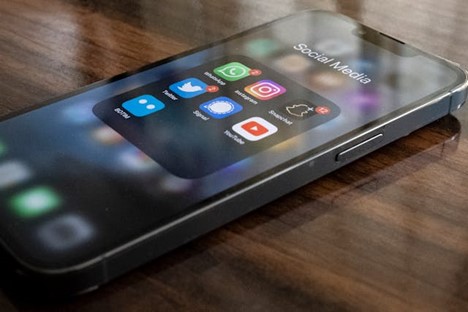
You really don’t need notifications from most of your apps. Turn them off.
2. Make Addictive Apps Harder to Access
Some people get hooked on TikTok. For others, it’s Candy Crush. Whatever app of choice is, you have several options.
One is to simply delete the apps that are problematic. If they’re not on your phone, you can’t use them. For something like Instagram, you can keep your account but only access it through a real computer rather than your phone.
Now, if you’re unwilling to do that, there are still steps you can take to create more distance.
The app you automatically open half the time you unlock your phone can be moved off of your home screen, so it’s not visible and not instantly accessible. You can hide it in a folder, so it takes a couple of swipes or clicks to open.
Or you can make it harder to get into your account. For instance, I don’t have the Facebook app on my phone, but I can still access it through the web browser, and, for a time, I was using it too much. So I opened it up in Chrome, logged out, and then told Chrome to not remember my password. Now, if I want to get into Facebook on my phone, I have to type in (and remember) my password, which is a hassle. This distance ensures that I never automatically and unthinkingly get lost in Facebook.
3. Spend Most of Your Time in Do-Not-Disturb Mode
Your phone comes with a built-in Do Not Disturb setting that you can probably use way more often.
But Chris, I have to keep my phone on. What if there’s an emergency with one of kids?
First, let’s remember that before cell phones, parents were frequently out of contact with their children for many hours of the day. And it was fine.
Second, did you know that iPhones have a more advanced version of Do Not Disturb mode? It blocks all notifications, but with a catch: “when someone calls twice within three minutes or texts the word ‘urgent,’ Apple’s iOS knows to let the call or message go through.” There’s also a “Do Not Disturb While Driving mode, which blocks calls and texts but also sends a message back to the sender that informs them you can’t pick up the phone at the moment. You can even customize the message.”9
It’s not that you should spend all of your time in Do Not Disturb, but surely you can find some time blocks in your day when 1) you really don’t need to be available and 2) you’d be better off doing focused work, giving your full attention to the person in front of you, or truly relaxing.

4. Spend More Time in Airplane Mode
The next level of distance between you and your phone is to keep it on your person, but to put it in airplane mode.
I’m writing this in the morning, and my phone is in airplane mode. I put it in airplane mode last night at 9pm and plugged it into the charger in our bedroom. It still worked as an alarm clock to wake me up. And I used the timer app for my morning meditation, but I haven’t taken it out of airplane mode yet.
This is a ritual I’ve used for years to 1) unwind at the end of the day, 2) avoid being woken up in the middle of the night, and 3) stay off of my phone first thing in the morning.
I also use airplane mode when I don’t want to have immediate access to the internet. If I unthinkingly pull my phone out of my pocket to check it (for no good reason) only to remember that it’s in airplane mode, I have an opportunity to say “no” because I don’t have instant access. It’s not hard to pull up settings and turn airplane mode off, but the few seconds it takes to do that is enough of a barrier to break me out of the spell of mindlessly checking my phone.
5. Spend More Time Away from Your Phone
Finally, we can simply spend more time away from our phones. Like, physically in a different room or different location altogether.

If you’re reading, put it in another room. If you’re going for a walk, leave it at home. Don’t take it with you when you go kayaking or paddle boarding. On a hike, bury it deep in your backpack rather than leaving it in your pocket.
If the thought of being without your phone makes you anxious, that’s a clear sign you’ll really benefit from spending less time with it. Remember, we feel the most resistance for the things we most need to do.
P.S. Do you want to help your kids learn to manage digital technology, so they can be tech savvy without being tech addicted? Then you’ll want to join us next week for the first class in this summer’s Parenting for Academic Success series. Click here to learn more.
1Skowronek, J., Seifert, A. & Lindberg, S. The mere presence of a smartphone reduces basal attentional performance. Sci Rep 13, 9363 (2023). https://doi.org/10.1038/s41598-023-36256-4
2Tanil, C. T., & Yong, M. H. (2020). Mobile phones: The effect of its presence on learning and memory. PloS one, 15(8), e0219233. https://doi.org/10.1371/journal.pone.0219233
3Adrian F. Ward, Kristen Duke, Ayelet Gneezy, and Maarten W. Bos. Brain Drain: The Mere Presence of One’s Own Smartphone Reduces Available Cognitive Capacity. Journal of the Association for Consumer Research. Volume 2, Number 2. April 2017. https://doi.org/10.1086/691462
4The Mere Presence of Your Smartphone Reduces Brain Power, Study Shows. UT News. Jun 26, 2017
5Swales, Shannon A. “The Burnout Trigger No One Talks About: How our phones quietly fuel exhaustion—and what can restore your energy.” Psychology Today. March 24, 2025.
6“Blue light has a dark side.” Harvard Health Publishing. July 24, 2024.
7Kumari, Chhavi. “9 Signs Your Smartphone Is Making You Lazy.” Medium. September 4th, 2023.
8Carr, Nicholas. The Shallows: What the Internet Is Doing to Our Brains. W. W. Norton & Company, 2011.
9Eyal, Nir. Indistractable: How to Control Your Attention and Choose Your Life. BenBella Books, 2019. Video book summary.

Chris Loper has been writing about self-improvement and helping busy adults with habit formation since 2017.
He also writes an education blog for parents and students for Northwest Educational Services.
Along with Greg Smith, Chris is the cocreator of Parenting for Academic Success, a series of transformative classes that create empowered parents, confident students, and harmonious families.
His most recent endeavor combines his academic and habit-formation expertise to help students thrive in college. Visit SmartCollegeHabits.com to learn more.
In 2021, Chris published a humorous memoir titled Wood Floats and Other Brilliant Observations, a book that blends crazy stories with practical life lessons.
He lives in Issaquah, WA where he is the owner of South Cove Tutoring.